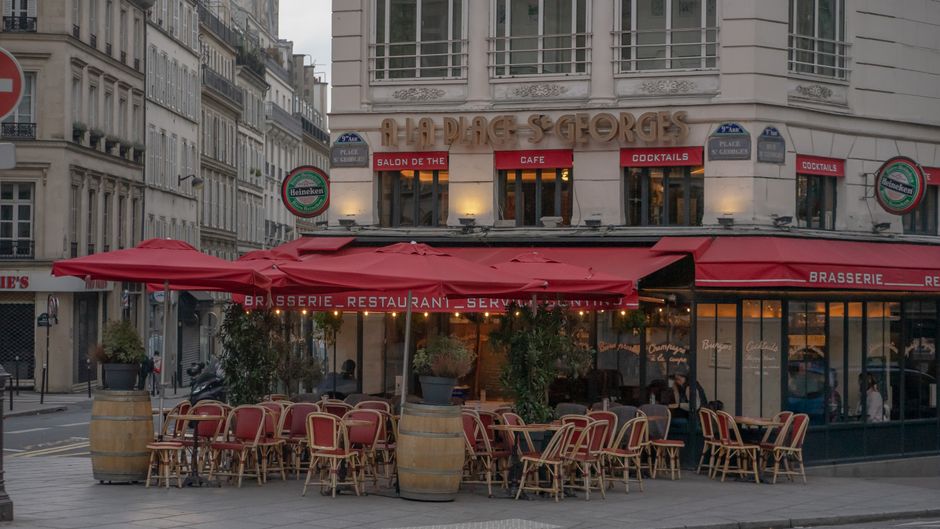
 Photo by Paul on Pexels
Aux Champs-Élysées: Lyrics, Meaning & History
Aux Champs-Élysées means "on the Champs-Élysées." The Joe Dassin lyrics translated, the story behind them, and the à + les contraction hiding in the title.
You've almost certainly heard it -- that impossibly cheerful la la la la chorus that starts up in every French film montage, every Paris tourism ad, every café playlist within ten minutes of you sitting down. Aux Champs-Élysées is the sound of Paris the way the world imagines Paris. What almost nobody outside France realizes is that the song is a small, complete story about picking up a stranger on the street -- and that its title alone contains one of the first grammar rules French learners have to get right.
That's the useful thing about this particular song. Most learners recognize the melody long before they can parse a single line of it, which means the hardest part of learning vocabulary -- remembering it -- is already done for you. And the title of Aux Champs-Élysées isn't just a place name: that aux is a contraction, the result of two words squashing together, and the same rule governs how you say "at the café," "to the beach," and "at the movies." Learn the song, and you get the grammar lesson attached to it whether you wanted it or not.
What the Title Actually Means
Aux Champs-Élysées (oh shahn-zay-lee-zay) means "on the Champs-Élysées" -- the wide, tree-lined avenue running from the Arc de Triomphe down toward the Place de la Concorde in Paris. The name itself is mythological: les Champs-Élysées translates literally as "the Elysian Fields," the paradise of Greek myth where heroes went after death. Whoever named a Paris street after the afterlife of heroes was not being modest.
The grammar hiding in the title is the piece worth taking home. Aux is not a word you look up on its own -- it's what happens when the preposition à (to, at, on, in) collides with the plural definite article les (the). French does not allow à les to sit next to each other; the two fuse into aux. Since Champs-Élysées is plural, "on the Champs-Élysées" has to come out as aux Champs-Élysées.
Key Phrases
- Aux Champs-Élysées (oh shahn-zay-lee-zay) -- on the Champs-Élysées
- Une avenue (ewn ah-vuh-new) -- an avenue
- Se promener (suh prom-nay) -- to stroll, to walk around
- Un inconnu (uhn an-koh-new) -- a stranger
[AUDIO: aux Champs-Élysées]
Grammar Note
À contracts with the definite article, but only in two of the four cases. Memorize the full set once and it stops being a decision you have to make:
- à + le = au -- au café (at the café)
- à + les = aux -- aux Champs-Élysées (on the Champs-Élysées)
- à + la = à la (no change) -- à la plage (at the beach)
- à + l' = à l' (no change) -- à l'hôtel (at the hotel)
- Common mistake: writing à le cinéma. It doesn't exist in French -- it's always au cinéma. The contraction isn't optional or stylistic; the uncontracted form is simply wrong.
- Common mistake: assuming aux is a plural of au. It is, functionally, but it's easier to remember it as à + les, since that tells you exactly when to use it.
The Story the Song Tells
Here's what most listeners miss entirely: the song has a plot. The narrator is walking down the avenue, hearts open to the unknown -- le coeur ouvert à l'inconnu, another à construction, this time contracted to à l'. He sees a stranger, says hello, and simply asks her anything at all, just to have something to say. She answers, and instead of brushing him off she invites him along to spend the evening with her and her friends, who are playing music in a basement club. They stay up all night, and by morning the two of them are strolling back down the same avenue, dazzled.
That's the whole thing. It's a story about the kind of chance encounter a big city makes possible -- a small, hopeful piece of 1969 optimism, set on the most famous street in France.
Key Phrases
- Bonjour, comment allez-vous ? (bohn-zhoor, koh-mahn tah-lay voo) -- Hello, how are you? (formal)
- N'importe quoi (nam-port kwah) -- anything at all, whatever
- Une guitare (ewn ghee-tar) -- a guitar
- Toute la nuit (toot lah nwee) -- all night long
[AUDIO: comment allez-vous]
The chorus is a genuine piece of French cultural shorthand: il y a tout ce que vous voulez aux Champs-Élysées -- "there's everything you could want on the Champs-Élysées." It's sung at French weddings, in stadiums, and by school groups on their first Paris trip. If you learn exactly one French singalong, this is the one that will actually get used.
The Song Isn't Originally French
This is the detail that surprises almost everyone, French listeners included. The melody didn't come from France at all. It started life as Waterloo Road, a 1968 song by the British band Jason Crest, written by Mike Wilsh and Mike Deighan -- named after a road in London, not an avenue in Paris.
Pierre Delanoë, one of the most prolific French lyricists of the twentieth century, wrote entirely new French words to that melody and moved the story from London to Paris. Joe Dassin recorded it in 1969, and it became one of the defining hits of his career. Dassin himself is another surprise: he was American, born in New York, the son of the film director Jules Dassin, and he only settled in France as a young man. The most French song in the world was sung by an American, to a British tune.
Dassin died in 1980, at 41, at the height of his popularity. The song has long outlived him -- it still plays constantly on French radio, and there is a reasonable chance you'll hear it drifting out of a shop the first time you actually walk down the Champs-Élysées yourself.
Using the Grammar Beyond the Song
The à contractions in this one title cover a huge amount of everyday French, because à is how French says where you're going and where you are. Once the four forms are automatic, whole categories of sentences open up: je vais au marché (I'm going to the market), elle est à la banque (she's at the bank), on se retrouve aux toilettes ? (shall we meet by the restrooms?), il travaille à l'aéroport (he works at the airport).
The trick is that the contraction depends entirely on the gender and number of the noun that follows -- which means every time you learn a new noun, you're also learning which contraction it takes. Learning le marché and au marché together is barely more work than learning le marché alone, and it saves you from having to compute the rule mid-sentence.
Putting It Into Practice
Next time the song comes on, try listening for one thing only: every time you hear aux, au, à la, or à l', notice the noun that follows it. You'll catch the pattern faster from four minutes of a song you already half-know than from a page of drills.
Practice Exercises
- Fill in the blank: Je vais ___ cinéma ce soir. (to the movies)
- Fill in the blank: Elle est ___ plage. (at the beach)
- Translate: "There's everything you could want on the Champs-Élysées."
- True or false: Aux Champs-Élysées was originally written in French.
- Fill in the blank: Nous sommes ___ hôtel. (at the hotel)
- What two words combine to make aux?
Answer Key
- Je vais au cinéma ce soir. (à + le)
- Elle est à la plage. (no contraction with la)
- Il y a tout ce que vous voulez aux Champs-Élysées.
- False -- the melody comes from the 1968 British song Waterloo Road; Pierre Delanoë wrote new French lyrics for it.
- Nous sommes à l'hôtel. (before a vowel, à l')
- À + les.
One Song, One Rule Worth Keeping
- Aux Champs-Élysées means "on the Champs-Élysées," and that aux is à + les -- one of French's four contraction forms, alongside au, à la, and à l'.
- The song tells a real story: a chance street encounter that turns into an all-night evening with strangers and a walk home at dawn.
- The most French song in the world was a British tune, given French lyrics by Pierre Delanoë and sung by an American-born singer, Joe Dassin.
Put it on, listen for the contractions, and sing the la la la part loudly enough that the grammar sticks. Head to Passage's Grammar section for the full rules on French prepositions and articles, or try a round of Exercises to drill au, aux, à la, and à l' until choosing between them stops feeling like a decision.